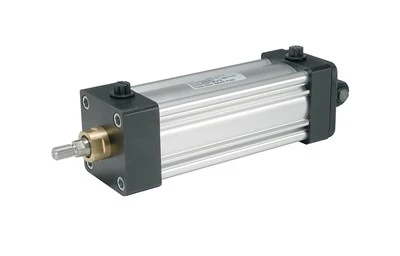
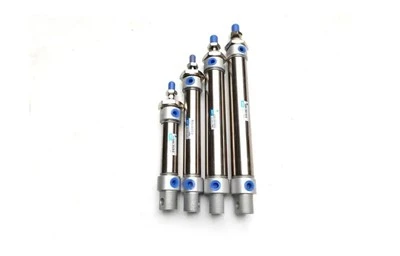
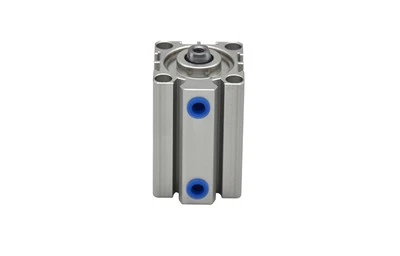
TWO-WAY SEALING DESIGN
The piston adopts a special-shaped two-way seal design structure
Occupies small space, strengthens piston performance, and has oil storage function
POWERFUL CYLINDER
The cylinder body is fully oxidized and adopts precision
Stainless steel, compressive and corrosion resistant
COMPACT SIZE AND GOOD SEALING
Compact size, tighter connection between the front and rear cover and the cylinder body,
better sealing
Product Specifications
|
Fluid |
Air |
|||
|
Proof pressure |
1.0 MPa |
|||
|
Max. operating pressure |
0.7 MPa |
|||
|
Min. operating pressure |
Ø6 |
Ø10 |
Ø16 |
|
|
0.12 MPa |
0.06 MPa |
|||
|
Ambient and fluid temperature |
-10 to +70℃. -10 to +60℃ with built-in magnet (No freezing) |
|||
|
Lubrication |
Not required (non-lube) |
|||
|
Cushion |
Rubber bumper |
Rubber bumper / Air cushion |
||
|
Piston speed |
50 to 750 mm/s |
|||
|
Allowable kinetic energy |
Rubber bumper |
0.012 J |
0.035 J |
0.090 J |
|
Air cushion |
- |
0.07 J |
0.18 J |
|
Installation and Handling
Air supply
The compressed air supplied to the cylinder should be filtered by SMC AF series air filter and regulated to the specified set pressure by SMC AR series regulator.
Use clean air
Do not use compressed air that contains chemicals, synthetic oils including organic solvents, salts or corrosive gases etc., as this can cause damage or malfunction
Caution
1.Install an air filter.
Install an air filter upstream near the valve. A filtration degree of 5 micron millimeter or less should be selected.
2.Take measure to ensure air quality, such as by installing an aftercooler, air dryer or water separator.
Compressed air that contains a large amount of moisture can cause malfunction of pneumatic equipment such as valves. Therefore, take appropriate measures to ensure air quality, such as providing an aftercooler, air dryer, or water separator.
3.Use the product within the specified fluid and ambient temperature range.
When operating at temperatures below 5oC, moisture in the circuit may freeze and cause breakage of seals or malfunction. Corrective measures should be taken to prevent freezing. For compressed air quality, refer to Best Pneumatics No.5.
4.Lubrication of non-lubricating cylinder
Install a lubricator in the circuit, and use Class 1 turbine oil (with no additive) ISO VG-32. Stopping lubrication later may lead to malfunction because the new lubricant will displace the original lubricant. Therefore, lubrication must be continued once it has been started.
Caution
1.Operate the product within a range so that the piston will not collide with the cover and be damaged at the stroke end.
If the piston with inertia force is stopped by colliding with the cover at the stroke end,operate the cylinder within a range that will not cause damage.
2.Avoid having a large gap between the clevis and mating bushing, as this exposes the pin to a bending load.
3.Do not let foreign matter such as cutting chips get into the product from the suction port.
4.Do not touch the cylinder during high speed and high frequency operation
When the cylinder is operating at a high speed and high frequency, the surface temperature of the cylinder tube increase, and may cause injury to personnel.
5.Do not use the air cylinder as an air-hydro cylinder.
If the working fluid of the air cylinder is turbine oil, oil leakage can result.
6.Grease is applied to cylinder.
7.The base oil of grease may seep out.
The base oil of grease in the cylinder may seep out of the tube, cover, crimped part or rod bushing depending on the operating conditions (ambient temperature 40 oC or more, pressurized condition, low frequency operation).
8.Resumption after a long stop.
When resuming operation after a long stop, there are cases in which the starting pressure rises or there is a delay in the piston starting time due to adhesion.Conducting several cycles of running-in operation will solve this problem. Please consider implementing this before resumption.
FAQ
Q: What is the smallest pneumatic cylinder?
Q: What are the three types of pneumatic cylinders?
Q: What is the disadvantage of pneumatic cylinder?
Hot Tags: cdj2b series mini cylinders, China cdj2b series mini cylinders manufacturers, suppliers, factory, air piston pneumatic cylinder, ma series mini cylinders, magnetic aluminum alloy mini air cylinder, mal aluminum alloy mini cylinder, mini cylinders, stainless steel mini pneumatic air cylinder