

Hey there! I'm a supplier of finger cylinders, and today I wanna chat about the principle behind these nifty little devices. Finger cylinders, also known as grippers, are super important in the world of automation and industrial machinery. They're used to pick up, hold, and manipulate objects, making them a key component in all sorts of manufacturing processes.
So, how do they work? Well, at the heart of a finger cylinder is a simple yet effective mechanism that relies on pneumatic power. Pneumatics is all about using compressed air to generate motion, and it's a technology that's been around for ages. In a finger cylinder, compressed air is used to move the fingers or jaws of the gripper, allowing it to open and close.
Let's break it down step by step. First, we've got the cylinder body, which is usually made of metal or plastic. Inside the cylinder, there's a piston that's connected to the fingers or jaws of the gripper. When compressed air is introduced into the cylinder, it pushes against the piston, causing it to move. This movement is then transferred to the fingers or jaws, which open or close depending on the design of the cylinder.
There are two main types of finger cylinders: single-acting and double-acting. In a single-acting cylinder, compressed air is used to move the fingers or jaws in one direction, while a spring or other mechanism is used to return them to their original position. This type of cylinder is often used in applications where the gripper only needs to hold an object in one position.
On the other hand, a double-acting cylinder uses compressed air to move the fingers or jaws in both directions. This gives the gripper more flexibility and control, making it suitable for a wider range of applications. Double-acting cylinders are often used in applications where the gripper needs to pick up and release objects quickly and repeatedly.
Now, let's talk about some of the different designs of finger cylinders. One common design is the parallel type, which features two fingers or jaws that move in parallel to each other. This type of cylinder is great for gripping objects that are flat or have a regular shape. You can check out the MHZ2 Parallel Type Air Gripper for more info on this design.
Another popular design is the angular type, which features two fingers or jaws that move at an angle to each other. This type of cylinder is ideal for gripping objects that are round or have an irregular shape.
There are also multi-finger cylinders, which feature more than two fingers or jaws. These cylinders are often used in applications where the gripper needs to hold an object from multiple sides, providing a more secure grip.
In addition to the different designs, finger cylinders also come in a variety of sizes and shapes to suit different applications. Some cylinders are small and compact, making them ideal for use in tight spaces, while others are larger and more powerful, capable of gripping heavy objects.
So, why are finger cylinders so important in the world of automation and industrial machinery? Well, for starters, they offer a high degree of precision and control. Because they rely on pneumatic power, they can be easily adjusted to apply just the right amount of force to grip an object without damaging it.
They're also very reliable and durable. Pneumatic systems are known for their simplicity and robustness, which means that finger cylinders can operate for long periods of time without requiring much maintenance.
And let's not forget about their versatility. Finger cylinders can be used in a wide range of applications, from pick-and-place operations in manufacturing to sorting and packaging in logistics.
If you're in the market for finger cylinders, there are a few things to keep in mind. First, you'll need to consider the size and shape of the objects you'll be gripping. This will help you determine the appropriate size and design of the cylinder.

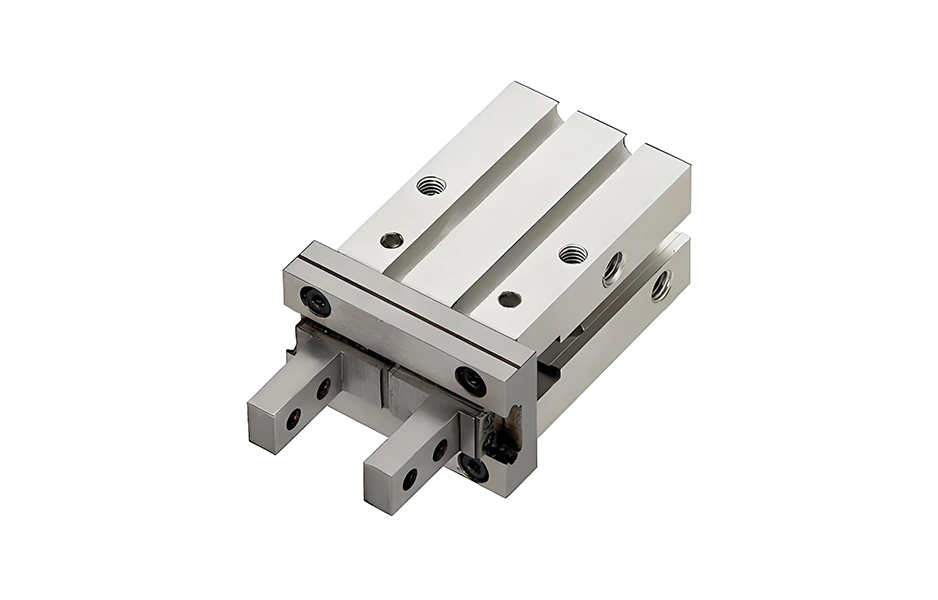
You'll also need to think about the force requirements of your application. How much force do you need to apply to grip the object securely? This will help you choose a cylinder with the right amount of gripping force.
Finally, you'll want to consider the operating environment. Will the cylinder be exposed to dust, dirt, or moisture? If so, you'll need to choose a cylinder that's designed to withstand these conditions.
As a supplier of finger cylinders, I'm here to help you find the right solution for your needs. Whether you're looking for a single-acting or double-acting cylinder, a parallel or angular design, or a multi-finger cylinder, I've got you covered. You can also explore our MHZ2 Single Acting Two Jaw Cylinder and MHZ2 Double Acting Two Jaw Cylinder for more options.
If you have any questions or need more information, don't hesitate to reach out. I'm always happy to chat and help you find the perfect finger cylinder for your application. Let's start a conversation and see how we can work together to improve your automation processes.
References
- Pneumatic Systems Handbook
- Industrial Automation Technology Textbooks